 By
By 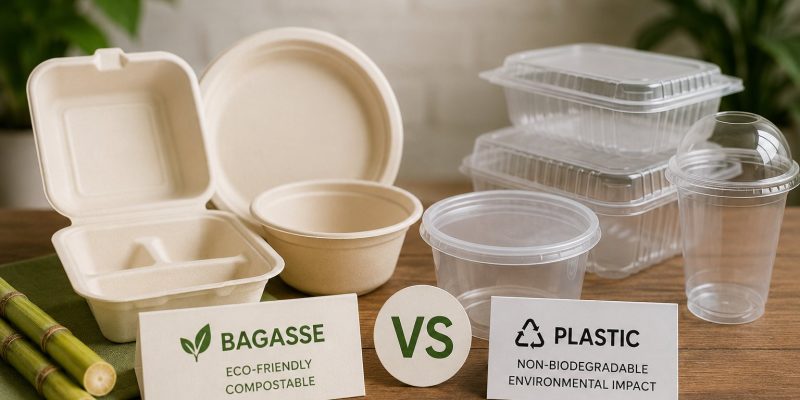
As Canadian restaurants adapt to evolving customer preferences and environmental regulations, you must choose the right food packaging supplies solutions. Whether you run a food truck, restaurant, café, catering business, or takeaway restaurant, you must choose the right container that impacts food quality, operating costs, and customer satisfaction.
Two of the most popular containers used are bagasse food containers and plastic food containers. Both have unique benefits, but the right choice depends on your menu, sustainability goals, and budget. In this blog, we tell you about the Bagasse vs Plastic Containers, look at performance comparison and key differences, and help you to make an informed decision.
What Are Bagasse Food Containers?
Bagasse food containers are made with sugarcane fiber, which is a by-product of sugar production. This fiber is processed into molded packaging like takeaway boxes, plates, bowls, and food trays. It is widely used as a plastic alternative in sustainable food packaging.
What Are Plastic Food Containers?
Plastic food containers are made with materials derived from petroleum, including polypropylene (PP), polyethylene (PE), and PET. It has been widely used for years because it is cheap and convenient. However, plastic packaging now faces growing scrutiny due to environmental issues and new regulations.
Performance Comparison: Bagasse vs Plastic Food Containers
For food service operations, how well containers perform in real conditions is the main practical factor. This comparison of Bagasse vs Plastic Containers looks at the key aspects that matter for takeaway, delivery, and dine-in services.
-
Heat Resistance
Bagasse containers keep their strength and shape at temperatures up to 95°C for liquids and up to 120°C in ovens or microwaves. It is suitable for hot meals, soups, sauces, and reheating without warping or leaching.
On the other hand, plastic containers can handle similar temperatures but may leach chemicals into food when heated. This issue has gained more attention in EU food safety laws. EPS containers tolerate lower heat and are banned in several EU countries. PET containers are unsuitable for hot food.
-
Grease and Moisture Resistance
Bagasse boxes resist grease up to 95°C and moisture up to 100°C without plastic coating. It has a dense fiber structure and creates a natural barrier that effectively handles oily foods, sauces, and wet ingredients.
Plastic boxes vary in grease and moisture resistance depending on the type of polymer. It offers good resistance, while PET is suitable for cold foods. EPS can soak up grease over time, which weakens the container and affects food presentation.
-
Structural Integrity in Delivery
Sugarcane Bagasse Containers are strong boxes and carry the food properly under the weight of stacking and transport. Its molded fiber design resists compression and does not bend under heavy stacked orders. This reliability is important for food delivery services that transport multiple orders at once.
Plastic containers are generally decent for delivery but can crack or bend on impact, especially in colder conditions. EPS containers break easily and can create a lot of litter when damaged.
-
Microwave Performance
Bagasse containers are safe for microwaving. It can easily heat food directly in them and eliminates the need to transfer it to another dish. It provides you with convenience for food delivery and meal prep.
On the other hand, PP containers are usually microwave-safe, but concerns about chemical migration at high temperatures are a factor in EU food safety evaluations. EPS and PET containers should not be used in microwaves.
-
Freezer Compatibility
Bagasse containers are suitable for freezing and keep their structure the same at low temperatures. It works well for meal prep, catering, and frozen food applications where the same container is used from freezing to reheating. Plastic containers ( PP) are safe for the freezer, whereas the PET and EPS containers have inconsistent performance on the basis of specific formulations.
PP containers are typically safe for the freezer, while PET and EPS containers have inconsistent performance depending on their specific formulations.
-
Condensation Management
A common issue with plastic containers during delivery is condensation build-up inside, which can make food, especially fried items, soggy. Bagasse containers naturally absorb moisture, managing condensation better than plastic surfaces and helping maintain food texture during delivery.
Comparison Table: Bagasse vs. Plastic Containers
Here is the detailed comparison of Bagasse vs Plastic Containers
| Aspect | Bagasse Containers | Plastic Containers |
| Material | Sugarcane fiber (plant-based) | Petroleum-based plastic (e.g., PP, PET) |
| Biodegradability | Compostable in 60–90 days | Not biodegradable; lasts hundreds of years |
| Environmental Impact | Low carbon footprint, sustainable | High emissions, pollution risk |
| Food Safety | BPA-free, chemical-free | May leach chemicals under heat |
| Heat Resistance | Microwave & freezer safe | Varies by plastic type |
| Cost | Moderately higher upfront | Usually cheaper initially |
| Best Use | Eco-conscious restaurants, hot/cold foods | Cold foods, drinks, short-term storage |
Which Food Packaging Option is More Sustainable?
When comparing Bagasse vs Plastic Containers, it is clear that bagasse has a much lower environmental impact. While plastic is strong, moisture-resistant, and cost-effective in the short term, its long-lasting ecological effects are worrying. In contrast, bagasse, though a bit pricier and with limited barrier properties, offers a fully biodegradable and compostable option that meets sustainability goals.
Can Restaurants Use Both?
Yes, restaurants can use both containers. There are many Canadian restaurants that use both materials based on their menu. For example, they can use
- Plastic containers for salads
- Bagasse containers for hot meals
- Bagasse clamshells for burgers
- Plastic deli containers for sauces
- Plastic cups for cold drinks
It helps your businesses balance sustainability, functionality, and cost.
Conclusion
When comparing the Bagasse vs Plastic Containers, bagasse emerges as the sustainable choice. Even plastic is preferred for durability and cost, but its long-term environmental impact is not overlooked. Bagasse is compostable, biodegradable, and made with renewable sources, providing you with a solid alternative and supporting the global efforts to reduce plastic pollution.
As consumers increasingly demand sustainable packaging and regulations become stricter, businesses should consider switching to eco-friendly options like bagasse to reduce their environmental impact and encourage a greener future.
FAQs
1. What are the disadvantages of bagasse containers?
Ans: The Bagasse containers may have a higher upfront cost than plastic, and their proper disposal relies on composting facilities. Without composting it, it ends up in landfills.
2. Are bagasse containers better than plastic containers for restaurants?
Ans: Yes, it is better than plastic containers because it prioritizes sustainability. The plastic containers also provide excellent durability and leak resistance. The best choice depends on your menu, budget, and packaging needs.
3. Are bagasse containers safe for hot food?
Ans: Yes, it is safe for hot food. It is food-grade, heat-resistant, grease-resistant, and suitable for hot meals like rice, pasta, burgers, and takeaway dishes.
4. Can Canadian restaurants use both bagasse and plastic food containers?
Ans: Yes, they can use both containers, bagasse for hot meals and plastic containers for salads, desserts, sauces, and cold foods. In this way, it balances functionality, sustainability, presentation, and cost.
5. Which food container is more cost-effective for small restaurants?
Ans: Plastic containers are more cost-effective for small restaurants and cost less upfront. The bagasse containers may provide you with long-term benefits in the form of a better brand image and eco-friendly solutions.